Peace
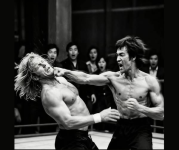
He claimed he was faster than Bruce Lee.
A martial arts instructor who had gained attention in Hollywood through his flashy, revolutionary demonstrations.
“Bruce Lee is nothing more than a showman,” he said.
“I’ve faced the best fighters in the country, and none of them lasted more than two minutes against me.”
—
Bruce Lee waited for him in the center of the gym, barefoot, wearing simple black pants.
“Thank you for coming,” Bruce said, extending his hand with genuine respect.
Lewis shook it firmly—perhaps too firmly, as if trying to assert dominance from the very start.
“No problem,” Lewis replied. “I was curious to see what you could teach me.”
“Let’s start with something simple,” Bruce suggested.
“I’d like you to try to punch me. A straight punch, with full speed and power. I won’t counterattack. I’ll only step aside to evade it.”
“You’re sure about that?”
The karate champion settled into a perfect fighting stance. Lewis took a deep breath and focused.
His fist sliced through the air at impressive speed, aimed straight at Bruce Lee’s face.
But when the punch should have landed—Bruce was no longer there.
In the same fluid motion, while Lewis’s fist continued its empty trajectory, Bruce’s open hand stopped just two centimeters from the karate champion’s throat.
“If I wanted to,” Bruce said calmly,
“I could have ended this encounter right there.”
Lewis’s wounded pride turned into fierce determination.
He launched a combination—jab, cross, hook.
Three strikes in rapid succession, each powerful enough to finish an ordinary opponent.
Each punch met nothing but air.
And after every failed combination, Bruce’s hand appeared at a vital point—
the throat,
the solar plexus,
the jaw.
“Do you want to know why you can’t touch me?” Bruce asked, without a trace of mockery in his voice.
“Your punches are powerful. Yes—and fast.
But you announce every strike before you throw it.
You tense your shoulder here.”
He lightly touched Lewis’s shoulder.
“You shift your weight here.”
He pointed to his hips.
“And your eyes give it away here.”
He gestured toward Lewis’s gaze.
“By the time your fist moves, I already know exactly where it’s going.”
—
“Now,” Bruce said, still wearing the same calm smile,
“let me show you something.”
Bruce stood in front of a heavy bag weighing about 70 kilograms.
He positioned himself just two centimeters from it.
Then—without any visible wind-up, without pulling back his arm or clearly rotating his hips—he struck.
The sound was like thunder in an enclosed space.
The bag bent inward at the center, absorbing an impact that seemed impossible given the lack of distance.
But the most astonishing part was the speed.
Lewis—considered one of the fastest strikers in karate—barely saw the movement at all.
It was like a flash. A burst of motion that defied perception.
“This is called the one-inch punch,” Bruce explained.
—
For the next two hours, Bruce worked with Joe Lewis.
To Lewis’s credit, he absorbed every lesson with the humility of a beginner.
At the end of the session, as Lewis prepared to leave, Bruce placed a hand on his shoulder.
“You have extraordinary talent,” Bruce said sincerely.
“Your speed and power are real. But now you know there are levels beyond what you imagined.”
“The question is—what will you do with this knowledge?”
Joe Lewis looked Bruce Lee in the eyes and, for the first time in many years, smiled with genuine humility.
“I’m going to learn,” he said.
“If you’ll accept me as a student, I want to train with you.”
“That was the day I understood the difference between being good and being great,” he later said.
“I was good. But Bruce Lee was something else entirely.”